 Munshi
To keep a record of who owes you money, keep one page per customer with the date, the amount, what it was for and a running balance, update it the moment credit is given or paid, and look at the total every week. That is a customer ledger. On paper it works if you are disciplined; in a khata app the balance and the totals are automatic. Here is the format, six rules, and the simplest way to do it on a phone.
The simple customer ledger format
| Date | What it was for | Credit given | Payment received | Balance |
|---|---|---|---|---|
| 3 Oct | Monthly rashan | 4,200 | 4,200 | |
| 10 Oct | Payment | 3,000 | 1,200 | |
| 18 Oct | Cooking oil | 2,300 | 3,500 |
The balance is always the last number: what the customer owes you now.
Six rules that keep it right
- One person, one page. No two spellings of the same name.
- Record at the moment, not at night.
- Write what it was for. A note settles most questions.
- Record payments as carefully as credit.
- Add a promised date to every large balance.
- Look at the total weekly, oldest balances first.
The same thing in Munshi
- Add the customer with a name and phone number.
- Tap You gave when you give credit, and enter the amount and a note.
- Tap You got when they pay.
- The balance reads in plain words, such as “Ali owes you Rs 3,500”.
- Home shows what you will get and what you will give across everyone.
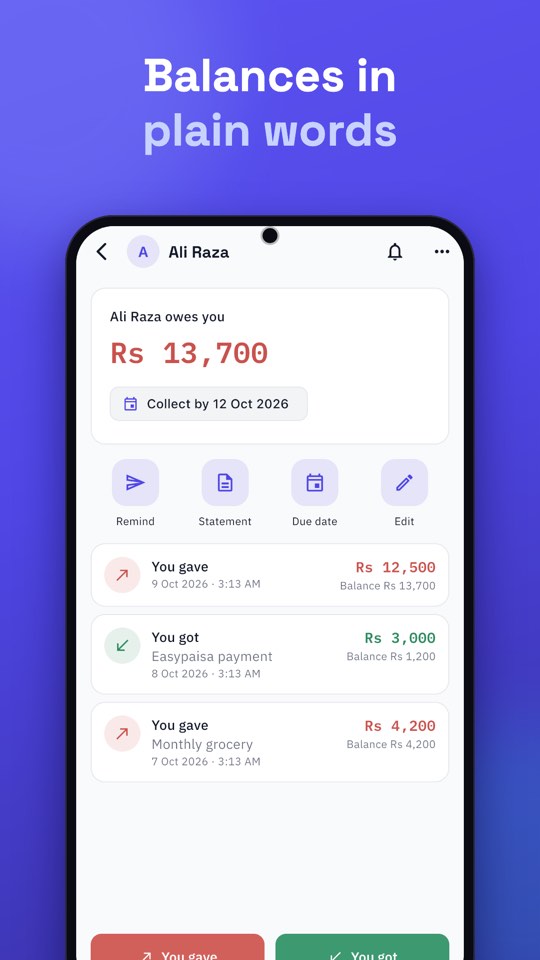
It works offline, in Urdu or English, and backs up daily on the phone.
Who owes me what, right now?
Open Reminders to see everyone with a balance, oldest first, and send a WhatsApp reminder in a tap; you press Send yourself. Set a collection date for many customers at once. For wording, see polite payment reminder messages.
Common mistakes in customer records
- Two pages for one person (“Ali”, “Ali Raza”, “Ali bhai”). Merge them, or the balance is never the whole truth.
- Recording only credit. If payments are not written, the balance only grows.
- No date and no reason. Without them, a dispute has nothing to stand on.
- Letting old balances sit. A balance of two weeks is a conversation; six months is a problem.
- Mixing personal lending with shop credit. Keep them in separate books; see Personal khata.
When a customer asks “how much do I owe?”
Open their page and read the balance. If they want proof, share a statement for the dates they ask about as a PDF; every entry is listed with its date. That one habit prevents most arguments, and it is easy once your record is accurate. See how to create a customer statement in Urdu.
Paper, Excel or an app?
- Paper is familiar but easy to lose and slow to total.
- Excel suits a short list at a desk. See Excel or a khata app.
- An app suits credit recorded at a counter. See what is a digital khata book.
For the full routine, read how to manage udhaar digitally, and for collecting what you are owed, getting paid faster as a small business.
Setting up your list of customers properly
The quality of your ledger depends on how you set it up. Spend an hour once, and it pays back every week:
- Make the master list. Everyone who currently owes you, and everyone you owe.
- Use full, recognisable names. The name you both say aloud.
- Add phone numbers. They enable reminders and help catch duplicates.
- Record opening balances once. From your old register, as of a clear date.
- Note agreed dates. For large balances, the date the customer promised.
The three questions your ledger should answer in ten seconds
- “How much does this person owe me?” Open their page and read the balance.
- “Who owes me the most?” Look at the list of balances; the biggest should be easy to see.
- “How much is outstanding in total?” Home shows what you will get.
If any of these takes more than a few seconds, your record is not yet working for you.
Dealing with disputed or doubtful balances
Some balances are uncomfortable: the customer disagrees, the entries are old, or the person has moved away. Handle them separately rather than letting them sit in the general list. Write down what you know: dates, amounts, notes, any messages. Share a statement and ask the customer to read it. Agree what is correct, fix what is wrong, and record the outcome. If a balance is truly uncollectable, decide consciously how you will treat it and keep the record of the history rather than erasing it. These are business decisions, and, for large amounts, ones to take advice on.
Weekly and monthly rhythms
A ledger is a habit, not a document. A useful rhythm is:
- Daily: record at the counter; count the cash.
- Weekly: open the reminders list, send messages, and look at the oldest balances.
- Monthly: share statements with your largest balances, review who should have a higher or lower credit limit, and back up.
Sharing the record with a partner or family
If you run the shop with a partner or family member, decide who records and who checks. Munshi works on more than one phone with the same account, so both can see the same balances. A short weekly conversation, with Home open on both phones, is often enough to keep two people aligned. Use App Lock on each phone, and agree not to delete entries without telling the other person. If you split the shop into separate businesses, each one’s numbers stay separate; see how to manage multiple businesses in one app.
What good looks like
When your customer ledger is working, you stop carrying numbers in your head. You know the total owed, who is overdue, and what you will say to them. Customers get clear statements and polite messages. And you sleep better. If you want the collection side, read a simple credit limit policy for your shop and WhatsApp payment reminder templates.