 Munshi
Munshi is a khata app: a digital version of the paper credit register that most Pakistani shopkeepers already keep. It records who owes you and whom you owe, works without internet, speaks Urdu and English, and is free to use. We built it at DIGIT because the way business really runs here deserved better tools than a notebook and a good memory.
The khata is how Pakistan does business
Walk into almost any neighbourhood shop, tailor, pharmacy or wholesaler and you will hear the same word: khata. A customer takes what they need today and settles later. “Likh lo” (“note it down”) is a complete financial agreement.
This system exists because it works. It is built on trust and relationships, not on credit scores. It lets families buy groceries before the month’s salary arrives, and it lets a shopkeeper hold on to a customer for years. Credit is not a side feature of small trade here. It is the trade.
Where paper and memory break down
The register that carries so much trust is also fragile.
- Pages get lost, torn or damaged. One wet monsoon or one misplaced notebook can erase months of what you are owed.
- Disputes are hard to settle. “I paid you last week” is hard to answer when the entry is a scribble from three people’s handwriting.
- Nobody can see the total. Ask a shopkeeper how much is outstanding right now and the honest answer is usually an estimate.
- Only one person holds the book. When the owner is away, the khata is closed too.
- Chasing is awkward. Without exact dates and amounts at hand, reminders turn into uncomfortable conversations.
None of this is a failure of the shopkeeper. It is a limit of the tool.
Why existing software did not fit
Accounting software exists, but it was largely designed for a different kind of business and a different kind of day. Looking at it with a Pakistani shop in mind, the gaps are plain:
- It assumes a laptop. Many small business owners here run their day from an Android phone.
- It assumes steady internet and power. A tool that stops when the connection or the electricity does is not much use at the counter.
- It assumes English and accounting vocabulary. “Receivables” and “journal entries” are not how a kiryana owner thinks. “Ali owes me 3,500” is.
- It assumes a subscription. A shop with thin margins will not pay a monthly fee for something it cannot yet see paying back.
What a khata app for Pakistan has to get right
Before writing any code we wrote down what would make a shopkeeper actually use it every day, in the middle of a rush:
- It must work offline. Entries save on the phone first and sync later. Power cuts and weak signals should never lose a sale.
- It must speak Urdu. The whole app, and the statements you share, in either language, and right to left where it should be.
- It must be one tap. “You gave” and “You got” right on the customer’s page. If it takes a minute, it will not happen at the counter.
- It must live where people already talk. Customers are on WhatsApp, so a reminder should open WhatsApp with the message ready. You press Send yourself; nothing goes out behind your back.
- It must be free. Offline use, more than one phone, Drive backup and reports should not be a paid tier.
- It must be private. A khata is your customers’ names and what they owe. It is not advertising material.
How Munshi answers that
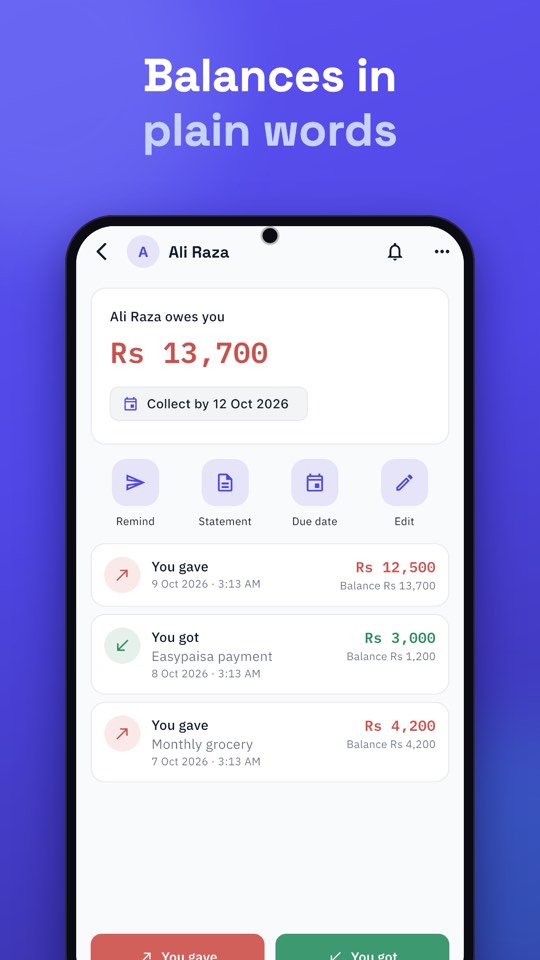
That list became Munshi. Balances are written in plain words, such as “Ali Raza owes you Rs 13,700”, with red for money you will get and green for money you will give. There is a daily Cash Book, bank accounts, expenses, reports for any dates as PDF or Excel, a Recycle bin for mistakes, and App Lock for the phone that gets passed around the family.
For people who run more than one business, Munshi now keeps up to five on one account, each with its own books. And because a lost phone should not mean a lost khata, you can sign in again with your number and your records come back, with an optional copy in your own Google Drive.
How it stays free
Servers, security and support cost money every month. Instead of charging shopkeepers, a few small ads marked “Ad” pay for them, and they never appear while you add an entry, sign in or send a reminder. We wrote the whole explanation in Why Munshi is free.
What we are still working on
Moving from a notebook or another app should be easy, so restoring a backup and importing a customer list from a sheet are in testing now. If something in your day is still done on paper and Munshi should handle it, tell us.
We did not set out to change how Pakistan trades. We set out to make the khata, which already works, safe, searchable and a little less awkward to collect on.
About DIGIT
Munshi is a product of DIGIT. Learn more about the team behind it at digit.com.pk, and read the details of how Munshi handles your data in our Privacy Policy.