 Munshi
A daily cash record has five lines: opening cash, cash in, cash out, closing cash and the difference from the cash you counted. Keep it on paper or in a cash book app on your phone, and close it every evening. It is the simplest control a small shop can have: if the record and the drawer agree, your day is right; if they do not, you know to look today, not at month end.
The one-page format
| Line | What goes here |
|---|---|
| Opening cash | Cash in the drawer when you open |
| + Cash in | Cash sales and payments received in cash |
| − Cash out | Purchases, rent, wages, transport and other payments in cash |
| = Closing cash (book) | Opening + in − out |
| Counted cash | What you actually count in the drawer |
| Difference | Counted minus book. Investigate if not zero |
What counts as cash in and cash out
- Cash in: a sale paid in cash, or a customer paying their udhaar in cash.
- Cash out: paying a supplier, an expense or wages in cash, or moving cash to the bank.
- Not cash in: a sale on credit (it is owed, not received), or a payment that went to your bank or wallet.
That last point is where most mistakes begin. See cash book vs khata vs bank book.
How to keep it on your phone with Munshi
- Open the Cash Book.
- Record each cash in and cash out as it happens, with an optional category or note.
- The balance updates after every entry.
- At closing, count the drawer and compare it with the Cash Book balance.
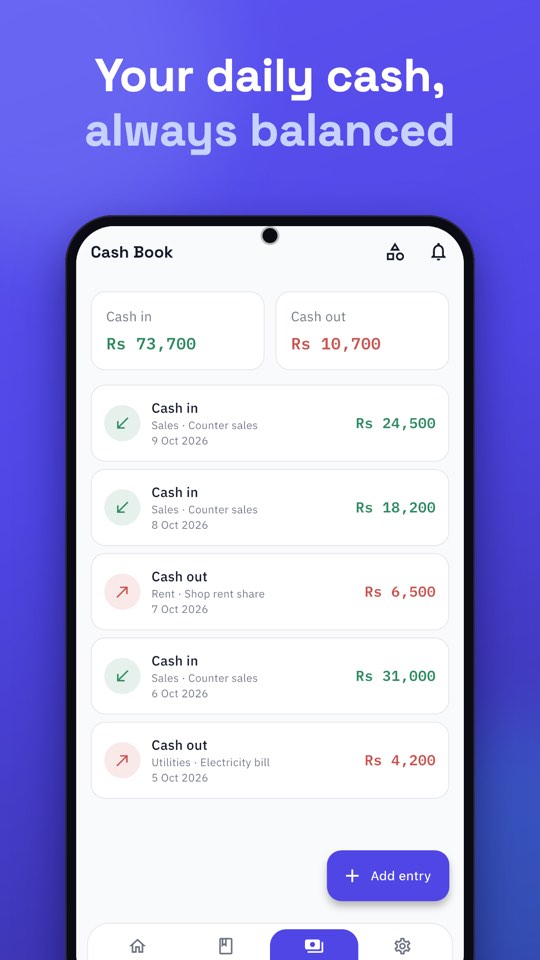
It works offline, in Urdu or English, and you can open a Cash Book report for any dates and share it as PDF or Excel.
Close the day in five minutes
- Make sure every cash sale and payment is recorded.
- Count the drawer.
- Compare it with the book balance.
- If there is a difference, check the last few entries, then the day’s receipts.
- Put the opening cash for tomorrow aside.
A weekly and monthly view
A daily record becomes powerful when you look across days. Once a week, open the Cash Book report for the last seven days and read three things: the biggest cash outs, whether cash in matches what you expected, and any day with a difference. Once a month, compare the month with the last one. A rising cash out category, or a day that never balances, is usually where a leak is.
An example day
Opening cash Rs 5,000. Cash sales Rs 22,000 and a customer’s payment of Rs 3,000: cash in Rs 25,000. Stock bought Rs 12,000, wages Rs 2,000 and transport Rs 500: cash out Rs 14,500. Book closing = 5,000 + 25,000 − 14,500 = Rs 15,500. If the drawer holds Rs 15,300, the difference is Rs 200: look for a missed expense or wrong change. These figures are only an illustration.
Common reasons for a difference
- A sale or expense that was never recorded.
- A credit sale recorded as cash in.
- Cash taken for the household and not written down.
- Wrong change given, or an amount typed wrongly.
For spending detail, see how to track business expenses in Pakistan, and for choosing an app, what app to use for cash in and cash out.
Setting the opening cash (the float)
Every day should begin with a known amount in the drawer, often called the float. Decide how much you want to keep for change, and take any excess to a safe place at closing. When the opening cash is the same each morning, your daily record is easier to read: a day that “gained” Rs 3,000 in the drawer is obviously a day to look at. Write the float in your first Cash Book entry of the day or keep it in your head and compare at closing. Consistency is what matters.
Handling coins, small notes and change
Small differences often come from change. Keep coins and small notes in separate compartments, and count them separately at closing. If a customer pays with a large note and you give change from the drawer, the cash in is the full amount and your sale is smaller; recording the sale as the price is fine, as long as the drawer ends up right. If you often run short of change, a small standing cash-out to “change” and a matching entry when you restock keeps your count honest.
Cash on delivery and collections away from the shop
If you deliver goods or collect payments outside the shop, treat the cash you carry as part of your drawer. Record the delivery’s cash in when it arrives, and note the customer or order. When you hand the cash to the shop, no new cash in is needed; it is simply in the drawer. Agree with the person who delivers that they record or report amounts at the end of each trip, so nothing sits in a pocket overnight unrecorded.
What to do when the difference is large
- Stop and count again, slowly, once.
- Compare with yesterday’s closing. Is the opening cash what you expected?
- List the day’s large cash-outs. Is one missing?
- Check deposits. Did you take cash to the bank without recording it?
- Check household withdrawals. Was cash taken home?
- Ask anyone who used the drawer. Calmly, as a question, not an accusation.
- If still unresolved, record a clearly labelled adjustment and keep an eye on the next few days.
Daily record versus monthly view
The daily record keeps the drawer right; the monthly view tells you what the business is doing. At month end, open the Cash Book report for the month and read the totals. Compare cash in with what you expected from sales and customer payments, and cash out by category. If you also use the Expense report, you can see which categories take the most money. Keep your notes short but specific so you can understand a line a month later. For more on categories, see how to track business expenses in Pakistan.
Bringing the bank into the picture
If you deposit cash into a bank, you will want your Bank Book to reflect it. Record a cash out in the Cash Book and a deposit in the Bank Book on the same day, with the same amount, and a note such as “deposit slip 5521”. Then your drawer and your bank balance both stay right. See how to record Easypaisa, JazzCash and bank payments and cash book vs khata vs bank book.